
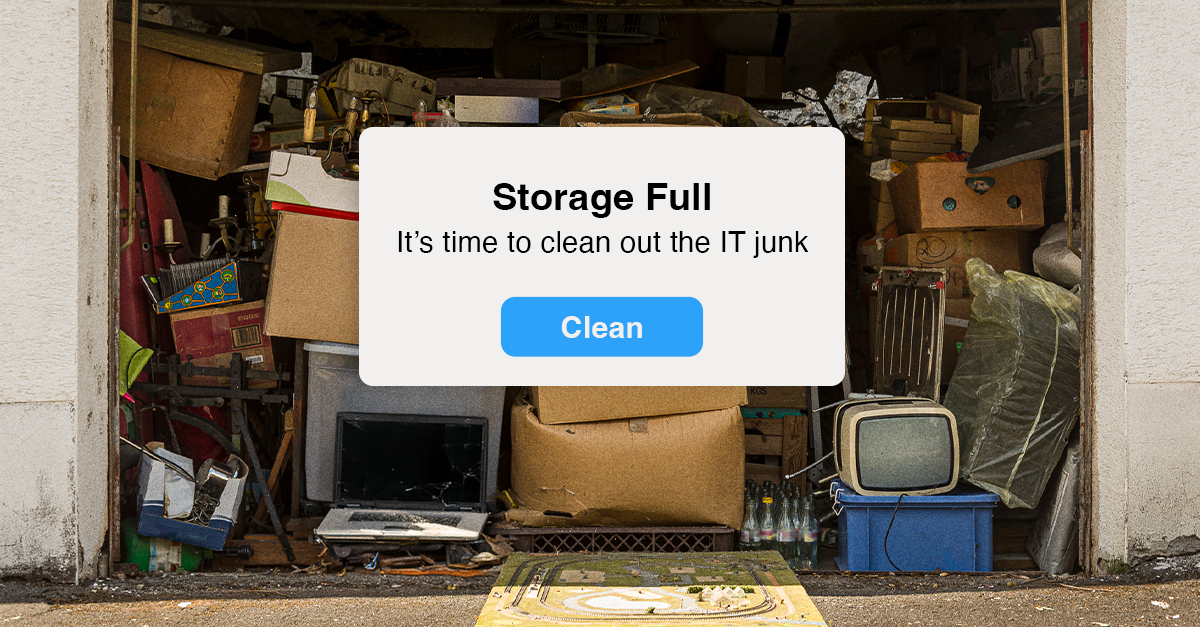
When did you last open that “ignore it for now” part of your IT systems?
Every company has one. Not a physical cupboard, but a hidden collection of systems, apps and workarounds that quietly build up over time. From the outside everything seems organised enough but inside it is a different story.
It is the place where unused tools linger, old processes get buried, and “temporary fixes” quietly become permanent.
And because nothing is obviously broken, it rarely gets attention.
How IT clutter quietly builds
IT sprawl does not usually happen through big decisions. It happens through small, sensible ones.
- A tool is introduced to solve an immediate issue.
- A new platform is added as the business scales.
- A workaround is created to keep things moving during a busy period.
- Legacy software stays because removing it feels risky.
Individually, each choice makes sense. But over time, these decisions are rarely reviewed together. Slowly, a patchwork of systems builds up that no one fully owns or fully understands.
In most cases, this is not a sign of poor management. It is simply what happens when a business moves quickly.
What is typically hidden away?
Most “IT closets” contain a familiar mix:
- Software that is no longer really used
- Multiple tools doing almost the same job
- Systems left in place “just in case”
- Access for ex-employees that was never fully removed
- Temporary fixes that quietly became standard process
None of it feels urgent on its own, which is exactly why it gets overlooked.
The hidden cost of cluttered IT
The impact of IT clutter is rarely dramatic. It is gradual.
- Teams waste time figuring out where information lives.
- People are not always sure which system to trust.
- Maintenance effort increases without delivering real value.
- Costs rise slowly in the background without clear warning signs.
Nothing necessarily breaks, but everything takes a little more effort than it should.
Over time, that friction adds up.
Why leaving it too long makes it harder
The longer these systems stay in place, the more embedded they become.
Old tools become harder to switch off because something else now depends on them.
Workarounds are forgotten until something changes and they suddenly matter again.
And decisions made years ago start shaping how work has to be done today.
At that point, cleaning it up becomes more complex than it needed to be.
IT tidying is not about starting over
This is not about ripping everything out and rebuilding from scratch.
It is about stepping back and being intentional.
What is still useful should stay, but it should be understood.
What no longer adds value should be retired.
And what is duplicated or unclear should be simplified.
The aim is not disruption. It is control and clarity.
Why it matters for growth
When your IT landscape is clean and well understood, everything feels easier.
- Teams know where to go for what they need.
- Systems support decisions instead of slowing them down.
- Change feels manageable rather than risky.
- Growth becomes more deliberate and less reactive.
In short, your business has more space to move.
Start by looking inside
You do not need to fix everything immediately.
Start by simply opening the door. Review what is actually being used, what overlaps, and what may have been forgotten altogether.
Understanding what you have is the first step to improving it.
If it helps, a fresh perspective can make that process easier. A short conversation can often highlight what is redundant, what is valuable, and what is quietly creating friction behind the scenes.